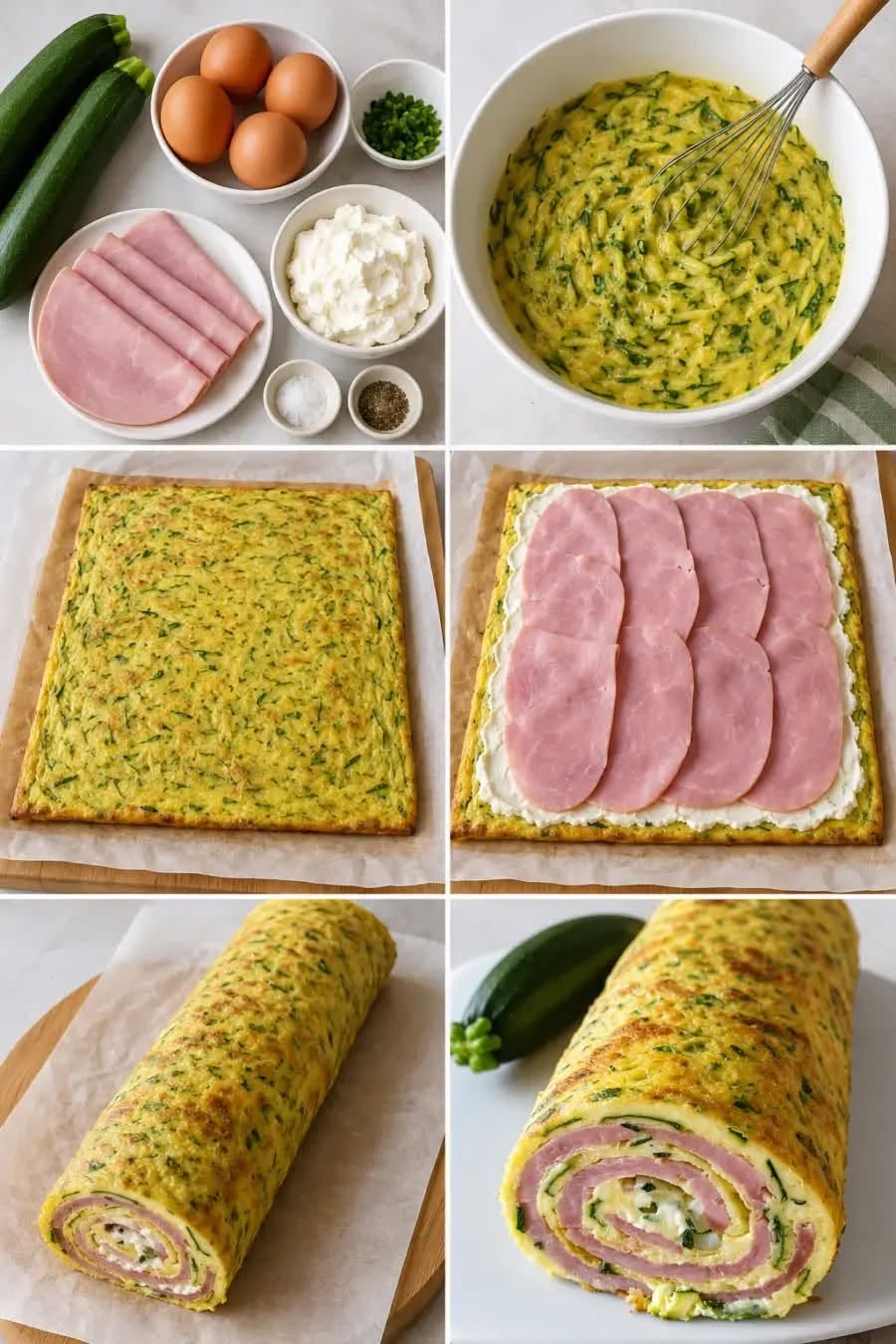
Step-by-step recipe preparation
1. Prepare the zucchini for a base that holds its shape
Start by grating the zucchini using a coarse grater. The finer and more uniform the strands, the more evenly the base will cook. Add a very light salt, mix with your fingertips, then let it rest for a few minutes.
This short resting period helps the zucchini release their water. This is an essential step for achieving moist but not soggy zucchini and ham rolls. Next, squeeze them firmly between your hands, in a clean tea towel, or in a fine-mesh sieve. You should really feel that the moisture has reduced: the mixture should feel compact, almost pliable like a slightly fibrous purée, and not damp to the touch.
If you still see a lot of water at the bottom of the bowl, repeat the draining process. This is often where everything hinges: a base that's too wet tears when rolling and doesn't brown properly when baked.
2. Mix the base
In a large bowl, whisk the eggs with the pepper, chopped herbs, and grated cheese. Add the well-drained courgettes, then mix thoroughly to coat each strand.
The mixture should be soft and slightly thick, but not runny. The zucchini should form a homogeneous mass with the egg and cheese, bound enough to spread into a rectangle without running. If the mixture still seems too wet, add just 1 tablespoon of breadcrumbs or all-purpose flour, then reassess. It's better to add too little than too much: the base should remain soft.
If you've chosen to add a spoonful of crème fraîche or yogurt, stir it in at this point. This will give it a more melt-in-your-mouth texture, especially if your zucchini are a bit thick or if you prefer a softer mouthfeel.
3. Spread into a rectangle
Preheat the oven to 180°C (350°F) for fan-assisted cooking, or 190°C (375°F) for conventional cooking. Line a baking sheet with parchment paper. Spread the mixture evenly, forming a large rectangle of uniform thickness, neither too thin nor too thick.
Ideally, you want a smooth surface that will bake evenly and can then be rolled without cracking. Consider leaving the edges slightly rough to make shaping easier. The layer should remain pliable after baking, but cooked enough to be handled.
For an even neater result, lightly press down with a spatula to avoid overly airy areas. However, don't compact it too much: the roulade should retain a light, almost melt-in-your-mouth texture.
4. Cook until firm
Bake for approximately 20 to 25 minutes, depending on your oven and the thickness of the base. The surface should be set, lightly golden at the edges, and fairly firm to the touch. When you gently touch the center, it should spring back without leaving a moist trace.
The base shouldn't brown excessively. You're aiming for a golden color, not a dry one. This precise baking will result in a roulade that's easy to handle and pleasant to slice, with a soft center and a lovely texture.
Keep an eye on it during the last few minutes: if the top is browning too quickly, you can very lightly cover it with a sheet of parchment paper. This prevents the surface from drying out while allowing the center to finish setting.
5. Unmold without breaking
Once out of the oven, let it rest for 2 to 3 minutes, allowing the base to cool slightly and firm up a bit. Then place a clean sheet of baking paper on top, carefully invert the baking sheet, and remove the original baking paper.
This step requires a gentle touch. The base should peel off easily without any sudden resistance. If it sticks a little, gently loosen it with a thin spatula. A well-baked base flips easily and retains a soft, slightly elastic texture.
Let it cool slightly before adding the filling. If you roll a base that's too hot, the ham can heat up too quickly and the whole thing becomes more fragile.
6. Garnish with the ham
Arrange the ham slices evenly over the entire surface, slightly overlapping them if necessary to cover the rectangle evenly. The goal is to obtain a uniform heart shape, visible when sliced, with a nice, clean pink spiral.
You can leave a small edge free on one side to make the seal neater when rolling. Press very lightly with the palm of your hand to adhere the ham to the slightly warmed base. At this stage, the roll is already starting to take on its final shape: supple, even, and delicious.
7. Roll tightly to form the spiral
Using the baking paper as a guide, begin rolling from the longer side. Use a firm but gradual motion, maintaining even pressure. You need to roll just enough to create a neat spiral without flattening the base.
A well-rolled pastry is recognizable by its shape: the cylinder should be compact, without a hole in the center, and the seam should be securely positioned underneath. If the base splits slightly, it's not a problem; simply continue rolling gently. Once formed, wrap the roll in parchment paper to help it hold its shape.
8. Set the shape in the oven or at rest
For a more stable finish, return the roulade to the oven for 5 to 8 minutes, still at 180°C (350°F), either wrapped in its baking paper or placed seam-side down. This brief reheating helps solidify the shape and the spirals hold their shape when cut.
If you prefer an even softer version, you can also let it rest for 10 to 15 minutes outside the oven before slicing. The roulade will naturally firm up as it cools. In either case, avoid cutting it immediately: a base that is still too hot will flatten and lose its beautiful spiral.
9. Slice cleanly
Use a sharp knife, ideally with a smooth blade. Cut slices 2 to 3 cm thick for a neat and generous presentation. Wipe the blade between cuts if necessary, especially if the ham is very soft or the roulade is still warm.
The successful slices show a clear alternation: golden exterior, soft yellow-green base, pink ham center, sometimes with herbs visible as small green dots. It is this spiral cut that makes the dish so striking.
10. Serve at the right time
Serve the zucchini and ham rolls warm, on a light-colored platter or directly on individual plates to showcase the vibrant colors. A simple crisp green salad, a few tomatoes when in season, or some dressed raw vegetables are all you need to complete the meal.
You can also add a drizzle of olive oil, some freshly chopped herbs at the last minute, or a grind of pepper to enhance the flavor. The dish remains light, but retains a truly generous feel thanks to the ham and cheese.
What to watch out for for perfect success
The first point is the water content of the zucchini. A well-drained base should feel firm and supple, never spongy. The second point is the cooking: the base should be set but not dry. The third point is the rolling: the more even it is, the prettier the spiral will be when sliced.
If your base is slightly sticking to the baking paper, let it cool for another minute before handling it. If it breaks, it's often because it's underbaked or has released too much water. In this case, it's best to roll it gently and tighten it gradually rather than forcing it all at once.
Chef's tips for increased comfort
For an even easier-to-handle roulade, you can prepare the base a little in advance and fill it when it's lukewarm, not piping hot. It will be more stable and the cut will be cleaner.
If you prefer a softer texture, a touch of crème fraîche or yogurt is a great idea. It softens the base and gives a more supple feel in the mouth, without weighing down the recipe.
Finally, if your zucchini are particularly watery, a dusting of breadcrumbs or light flour can save the texture. The idea isn't to transform the dish, but to provide just enough structure to maintain a consistent spiral.
Simple variations without betraying the recipe
You can vary the herbs according to the season: chives for a fresher note, parsley for a more vegetal aroma. The cheese can also slightly change the character of the dish: Gruyère adds a touch of sweetness, while Parmesan provides a more pronounced flavor and a slightly firmer base.
For a more rustic version, keep the ham filling generous and serve the roulade with a seasonal salad. For a more refined presentation, slice it thinner and arrange the spirals in a fan shape on a large plate.
Storage and preparation in advance
The roulade will keep for two days in the refrigerator, in an airtight container. It holds its shape well, especially if it has been left to rest before slicing. To serve it again, you can let it come to room temperature for a few minutes or warm it briefly in a low oven.
If you'd like to prepare it in advance, you can bake the base, let it cool slightly, then fill and roll it up later. This is convenient for stress-free entertaining. You can also roll it completely and refrigerate it before slicing it just before serving.
Freezing isn't the best option here, as the zucchini loses some of its firmness upon thawing. However, the recipe works very well if prepared in advance on the same day.
Approximate nutritional value
For a reasonable portion, this dish remains relatively light. The zucchini provides water, fiber, and freshness, while the eggs, cheese, and ham supply protein and flavor. Expect approximately 180 to 250 kcal per serving, depending on the thickness of the slices, the type of cheese chosen, and whether cream or yogurt is added.
FAQ
How to prevent a zucchini and ham roll from breaking?
Squeeze the zucchini very thoroughly after salting them, then bake the base until it is firm but still pliable. Let it cool slightly before adding the filling and roll it up gradually, without pulling the dough abruptly.
Can the courgette and ham rolls be prepared the day before?
Yes, you can prepare them in advance and keep them in the refrigerator, well wrapped in plastic wrap or in an airtight container. They even slice more cleanly after resting. Briefly reheat them in a moderate oven if you're serving them warm.
What cheese should I use for this recipe?
Grated Gruyère cheese provides a mild flavor and good texture, while Parmesan offers a more pronounced taste and a slightly firmer base. Both work very well, depending on the desired result and your cooking preferences.
Why does my courgette base release water after cooking?
This almost always happens when the zucchini hasn't been drained thoroughly. You really need to squeeze the pulp to remove excess moisture before mixing it with the eggs and cheese. Cooking it for too short a time can also contribute to this problem.
Can this roulade be served cold?
Yes, it can also be eaten cold, sliced, as an appetizer or on a buffet. The texture will be a little firmer and the spiral will remain nicely defined. However, serving it warm better highlights the creaminess, the aroma of the cheese, and the melt-in-your-mouth texture of the ham.
Conclusion
With its soft zucchini base, ham center, and neat spiral cut, this zucchini and ham roulade always makes a great impression without requiring any complicated technique. Serve it warm, share it straight from the oven, and keep the recipe handy for simple and delicious meals.
read more in next page