This may be the most important distinction to understand.
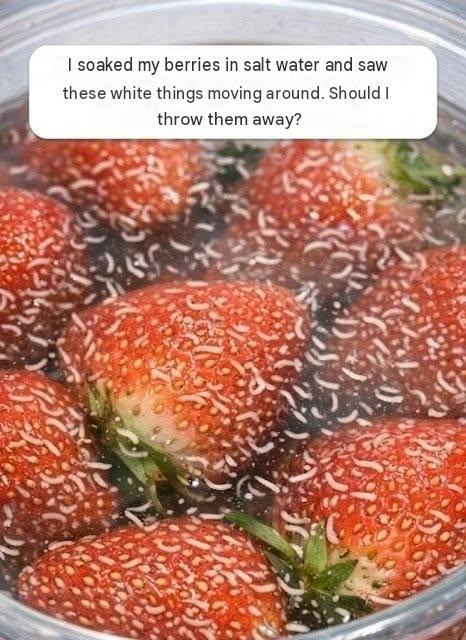
The presence of an insect or insect larva does not automatically mean that the fruit contains a dangerous toxin or pathogen.
However, that doesn't mean you should ignore what you find.
If you discover larvae in the fruit, especially if several berries appear to be affected, it is reasonable to take the situation seriously and avoid eating the suspect pieces.
Food safety is not about panicking at every unusual discovery.
It's about making sensible decisions based on the condition of the food.
For example, finding a single small insect on an otherwise fresh product is a different situation than finding a container full of soft, dripping, moldy, or visibly infested fruit.
The latter should generally be ruled out.
## What about washing fruit?
Washing fresh fruits and vegetables is a good general practice.
Before eating strawberries, blueberries, raspberries or other fresh fruit, rinse them with clean running water.
There is no need to use soap or household cleaning chemicals.
In fact, using detergents or other unsuitable cleaning products on food can create its own problems.
Running water helps remove dirt, debris, and some microorganisms from the surface of fruits and vegetables. It can also eliminate some insects that are simply on the surface.
However, the berries should be washed carefully because they are delicate.
Strawberries can be rinsed with cold tap water shortly before eating them. Handle them carefully to avoid damaging the fruit and causing it to spoil.
If possible, avoid washing the container completely for several days before consuming it.
Humidity can promote spoilage and mold growth, which can shorten the shelf life of the fruit.
A practical measure is to wash only the amount that will be consumed.
## Should you use salt water?
Saltwater baths have become popular because people like to see immediate results.
But it's important not to confuse a viral cleaning hack with an established food safety requirement.
There's no need to soak all berries in salt water just because a video on social media showed something coming out of some strawberries.
For routine cleaning of fruits and vegetables, it is generally best to use clean running water.
If it's fruit that looks damaged or has visible insects, the best solution may simply be to inspect it carefully and discard any suspicious parts.
If a container appears to be badly damaged, smells strange, contains a lot of mold, or looks very deteriorated, throwing it in the trash is usually the simplest and safest decision.
## What should you do if you see larvae?
Don't panic.
First, stop eating the fruit and inspect it.
Separate any berries that are visibly damaged, soft, moldy, dripping, or show any other suspicious symptoms.
If you find a single bad berry, you can choose to discard it and rinse the rest of the healthy fruit well.
However, if numerous berries contain visible larvae or signs of infestation, discarding the entire container may be the wisest option.
This is especially true if the fruit is already deteriorating.
If you recently purchased the berries, consider taking photos of the problem and contacting the store or the grower. Depending on where you bought them, you may be able to request a refund or report a quality issue.
There is no need to touch organisms unnecessarily.
Simply document what you found and dispose of the affected food properly.
## What if the berries look perfect?
This is where things get less dramatic.
Fresh strawberries may appear completely normal on the outside, even though they may have small damaged areas that are not visible to the naked eye.
But the fact that insects can occasionally be found in fresh produce does not mean that every seemingly perfect strawberry contains hidden worms.
Millions of people eat fresh berries every day without experiencing anything unusual.
Commercial fruit production also involves inspection, grading, packaging, transport, and handling at retail outlets. These processes reduce the likelihood of severely damaged produce reaching consumers, although they do not guarantee that every berry is completely insect-free.
Nature simply doesn't work that way.
## Why are strawberries particularly vulnerable?
Strawberries have a structure that makes them attractive to both people and various insects.
They are soft, sweet, fragrant, and contain a lot of moisture.
As strawberries ripen, their sugar content increases and their texture becomes softer. Damage from insects, inclement weather, handling, or birds can create additional opportunities for organisms to damage the fruit.
A bruised or cracked strawberry is more vulnerable than a firm, intact strawberry.
That's why it's so important to check the condition of the fruit.
Examine the packaging carefully when you take it home.
Are the berries firm?
Do they have bright, natural colors?
Are there any squashed pieces?
Is juice accumulating at the bottom?
Do you see cottony mold?
Are some berries unusually soft?
These observations are usually more useful than a "cleaning trick" that goes viral.
## What about other berries?
The same general principles apply to many types of fresh produce.
Blueberries, raspberries, blackberries, cherries, peaches, and other fruits can interact with insects during their cultivation.
Some fruits have natural imperfections that can be alarming when viewed under a magnifying glass or exposed to unusual conditions.
This does not mean you should be afraid of fresh produce.
Instead, it reinforces a basic lesson:
**Inspect food before consuming it, wash fresh fruits and vegetables thoroughly, and discard any food that is visibly spoiled or badly damaged.**
## Do not confuse insects with foodborne pathogens
Another common mistake is believing that if a larva comes out of a berry, the fruit must contain a dangerous infection.
That's not necessarily true.
Insects and microorganisms are different things.
A visible larva is an organism that can potentially be identified as an insect or similar creature. Foodborne pathogens, on the other hand, are usually microscopic and cannot be reliably detected with the naked eye.
A berry can appear perfectly clean and still contain harmful microorganisms.
Conversely, discovering a tiny insect does not automatically mean that the fruit contains a dangerous pathogen.
Therefore, it is important to follow proper food handling practices, regardless of whether anything unusual is observed.
Wash your hands before preparing food.
Keep fruits and vegetables away from raw meat and other foods that can cause cross-contamination.
Use clean utensils and surfaces.
Properly refrigerate perishable products.
And discard any food that shows obvious signs of spoilage.
## What about mold?
Mold is a different problem.
If you notice a cottony growth on a strawberry, don't assume you can simply cut off the affected part and eat the rest.
Soft fruits have a high moisture content, and mold can spread beyond the area that is immediately visible.
You will find the rest on the next page.