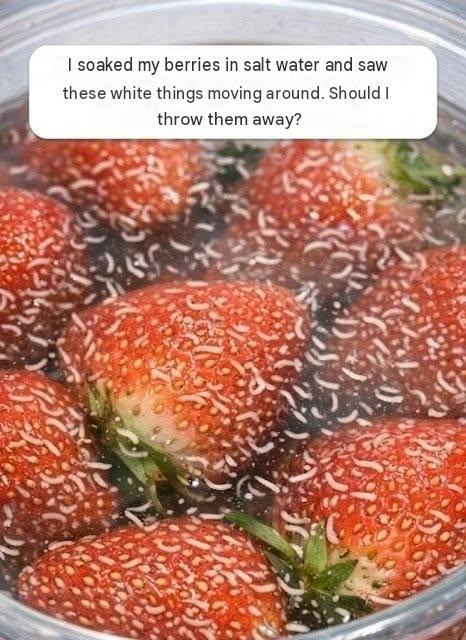
I soaked the berries in salt water and saw some small white things moving around. Should I throw them away?
I soaked my berries in salt water and small white worms came out. Should I throw them away? Here's the truth.
Imagine bringing home a container full of fresh strawberries from the supermarket, a street vendor, or your local farmers market. They look bright red, juicy, and perfectly ripe—the kind of fruit you're dying to eat.
But before taking the first bite, you remember a very popular cleaning trick you saw on the internet.
Fill a large bowl with water, add several tablespoons of salt, stir, and add the strawberries to the mixture.
At first, nothing seems out of the ordinary.
So you wait.
A few minutes later, you notice something moving in the water.
Tiny white, thread-like creatures appear to be emerging from among the berries.
Suddenly, those strawberries don't look so appetizing anymore.
You stare at the bowl and wonder: **Were those things living inside my fruit? Did I just discover worms in my strawberries? Should I throw the whole bowl away?**
Videos showing this phenomenon have been widely circulated online, often accompanied by alarming warnings about "worms" hiding inside strawberries. While some of the creatures shown could indeed be small insect larvae, the situation is more complex than many viral posts suggest.
What really happens when tiny creatures emerge from berries soaked in salt water?
Does that mean your fruit is dangerous to eat?
## Why do tiny creatures sometimes appear?
Strawberries and other soft fruits grow outdoors, where they are exposed to insects and other organisms throughout their development.
Some insects lay their eggs on or near the fruit. Under the right conditions, these eggs can develop into larvae. Because strawberries have numerous tiny seeds, cracks, and irregular surfaces, small insects can sometimes find places where their eggs or larvae are difficult to spot.
The same general principle applies to other fruits.
Berries, cherries, peaches, figs, and other soft produce may contain insects or insect damage. This is not necessarily evidence of poor farming practices or food contamination.
It's simply one of the realities of growing food outdoors.
Fruit is not produced in a completely sterile laboratory.
Pollinators visit flowers. Insects move among plants. Birds and other animals interact with crops. Farmers employ various agricultural practices to protect plants, but completely eliminating all insects from every fruit is neither realistic nor necessarily desirable.
Therefore, the important question is not simply: **"Did I see a small larva?"**
The most useful question is:
**"What does their presence tell me about the condition and safety of the fruit?"**
## What are those white, wavy things?
Not every tiny white object found in a container of soaking berries is necessarily a worm.
Depending on the fruit, the insects involved, and the conditions, what you're seeing could be insect larvae, pieces of plant material, or other small organisms.
Some larvae are extremely small and pale, making them look like tiny white threads as they move through the water.
In certain berries, fruit flies and other small insects may be associated with larvae that develop in damaged or overripe fruit. Some agricultural pests are also capable of laying their eggs in the fruit, where the larvae subsequently develop.
This is one of the reasons why damaged, bruised, or overripe fruit deserves a closer inspection.
But there is another important point:
**The fact that something appears after soaking the berries does not automatically prove that all the berries in the container are infested.**
It is possible that one piece of fruit has attracted an insect, while the rest may be completely intact.
## Why does salt water make them come out?
This is where many viral posts can be misleading.
On the internet, salt water is often presented as a magical method for eliminating insects hidden in fruit.
This observation makes sense: soaking produce can cause small organisms on or near the surface to move or become more visible. A saline solution can also alter the environment of these small organisms.
But that doesn't mean that salt water is a scientifically guaranteed method for removing any insects, larvae, or contaminants from fruit.
The internet often turns a simple domestic observation into a universal food safety standard.
That's where consumers need to be careful.
If you notice something moving in the soaking water, don't immediately assume you've discovered a dangerous pest.
Instead, examine the fruit itself.
Look for visible damage, unusual soft spots, mold, juice leaks, unpleasant odors, or signs that the fruit is rotting.
These characteristics tell you much more about whether the fruit should be eaten or not.
Does finding a larva mean strawberries are dangerous?
Not necessarily.
You will find the rest on the next page.