"Mom? Are you there?" Audrey's voice crackled on the phone, thick with anxiety. "What's going on? Dad never calls me just to talk about your schedule. He sounded... terrified."
I closed my eyes, drawing on decades of military discipline to maintain a perfectly calm voice. "I'm fine, Audrey. I'm in Nashville. I came back early from leave to surprise her."
"Then why are you at the hotel?" she asked, her sharp mind having immediately detected the omission. "Mom, please don't lie to me."
"I'm assessing the situation," I said, using the tactical language she'd always heard. "Don't tell your father you spoke to me. If he calls back, you won't know. Could you do this for me, Colonel's daughter?"
A long silence fell at the other end of the line. "Yes, madam," she murmured.
After hanging up, I glanced down at my dress uniform, neatly arranged on the hotel room bed. The medals, the ribbons, the silver star insignia—it all symbolized a lifetime of sacrifice. While I commanded logistics battalions in areas of intense conflict, ensuring thousands of soldiers were fed, armed, and housed, Graham ran his own logistics business.
I sat back down in front of my laptop. This time, I didn't look at Celeste's photos on social media. I consulted the company documents.
Over the past four years, Whitlock Freight & Supply has secured three major subcontracts from the Department of Defense, totaling $42 million. The bidding process for federal military contracts is known for its rigor; it requires extensive due diligence, spousal asset disclosure, and strict adherence to anti-nepotism regulations.
I opened my personal secure military portal and reviewed my own financial statements.
And there it was. Deep within the appendices to Graham's tax returns at the Department of Defense, my signature had been forged on a series of spouse waiver forms. He had used my active duty status, security clearance, and decorated military record to secure preferential treatment in bidding processes, as a "veteran-related and minority-owned" company, for his business.
But the problem ran deeper. To maintain the illusion of a businessman's wife who was present and active at charity events and federal galas without raising questions about my true deployment locations—which were classified—he had simply hired an actress.
Celeste was more than just a fling. She was a tool of manipulation for the company. A living identity theft, designed to play the role of "Mrs. Whitlock" to the board of directors, federal auditors, and the local press, while the real Mrs. Whitlock was abroad serving her country.
He hadn't just replaced me in his bed. He had exploited my entire career to finance his empire.
And now, the security guard at reception had probably sent him a text message saying that a woman in military uniform was asking for him. Graham knew his house of cards was about to collapse.
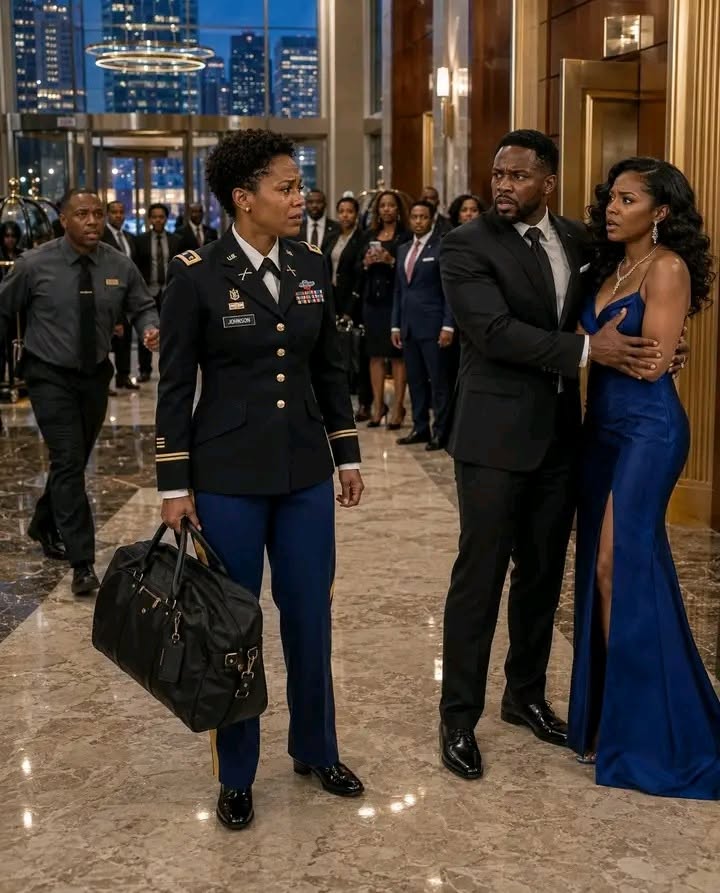
The next morning, I wasn't wearing a suit. I was in full ceremonial uniform. Every ribbon was perfectly aligned. Every brass button shone like a mirror.
I didn't take an Uber. I entered the Whitlock Freight & Supply lobby at precisely 9:00 AM.
The gray-haired security guard from the day before paled as soon as he saw me heading towards the tourniquets. "Madam... well, Colonel..."
"Get out of the way, fist," I said in a voice imbued with the calm and absolute authority of a senior officer.
He didn't dare challenge me.
I took the executive elevator directly to the top floor. When the doors opened, the receptionist stood up, stunned, but I completely ignored her and walked purposefully towards the double mahogany doors of the CEO's office, in the carpeted corridor.
I opened them without knocking.
Graham stood by the window, a trembling cup of coffee in his hand. Seated on the leather sofa, Celeste wore a fitted navy dress. Around her neck, glittering in the morning light, shone my silver star pendant.