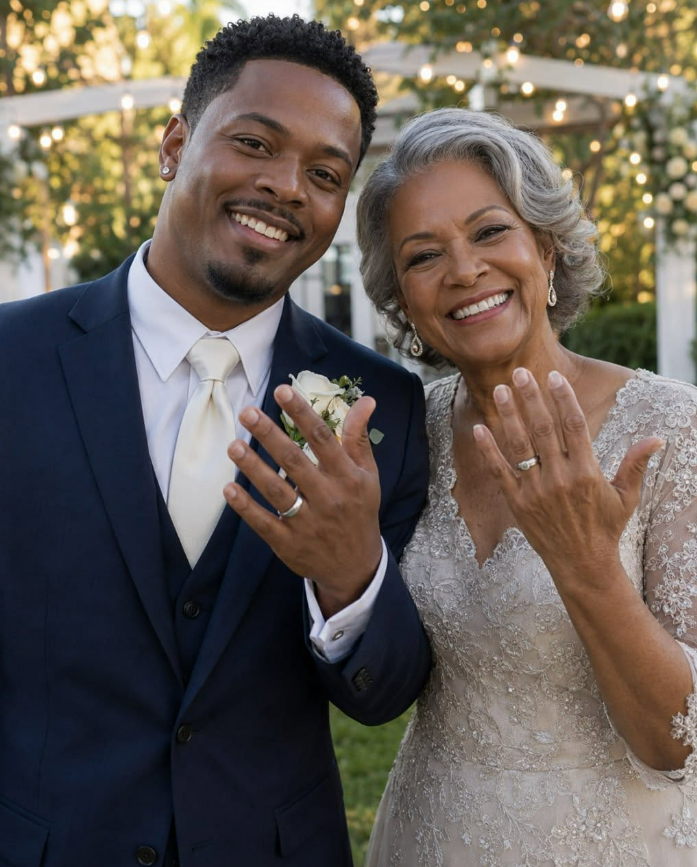
The resemblance was undeniable.
Grandma’s letter continued.
I did not tell you because Marianne trusted me with the story of her abuse. Her death did not release me from that promise automatically.
Martin also feared that revealing the connection would make our relationship look like repayment rather than choice.
He did not marry me because I rescued him.
He married me after discovering I was still capable of making him laugh when he believed grief had ended that part of his life.
I married him because he never treated my age as permission to stop seeing me as a woman.
You believed you were protecting me.
I know that came from love.
But love becomes dangerous when protection requires taking away another person’s judgment.
You watched Martin for evidence of greed and missed the evidence of care because care was quieter.
I cried before reaching the final page.
Not delicately.
I folded over the table with my grandmother’s letter pressed against my chest.
Every act I had classified as manipulation returned differently.
Martin remembering her medicine.
His refusal to accept property.
The photograph in his hands.
His anger when Grandma wanted to reveal the past.
His calmness when I threatened him.
He had known why I was afraid.
He also knew explaining himself would require exposing his mother’s most painful years.
He chose to let me despise him rather than use her suffering as a defense.
That was the kind of man I had spent two years trying to expose.
I found him the following morning at the county archive.
He sat alone in the conservation room repairing the spine of an old hymnal.
Grandpa’s model ship rested on a nearby table.
He looked up when I entered.
“You read it.”
“Yes.”
He set down his tools.
“I am sorry.”
His expression became confused.
“For what?”
“For treating you like a criminal.”
“You were afraid for her.”
“That does not excuse everything.”
“No.”
I appreciated that he did not rush to absolve me.
“I searched your records.”
“I assumed.”
“I lied to test you.”
“I knew about the animal shelter.”
My face burned.
“Grandma told you?”
“She asked whether I wanted to help choose one.”
Despite myself, I laughed.
The sound became a sob.
Martin stood but did not approach.
“I thought you were waiting for her to die.”
His eyes filled.
“I spent every day wishing time would stop.”
There was nothing clever to say after that.
“I owe you more than one apology.”
“Probably.”
I nodded.
“Will you let me begin?”
He looked toward the model ship.
“One condition.”
“Anything.”
“Do not call me Grandpa Junior.”
I stared at him.
“How did you know?”
“Your face said it every time you looked at me.”
I laughed again.
This time he did too.
We did not become family immediately.
Apologies do not erase surveillance, accusations, and mistrust.
Martin needed time.
So did I.
We began with practical things.
Sorting Grandma’s books.
Finishing the model ship.
Deciding which photographs to copy.
He taught me how to repair torn paper with tissue so thin it nearly disappeared.
I learned that he hated mushrooms, loved old detective films, and had cared for Julia through three years of cancer treatment.
He learned that my suspicion was not only greed.
I had already lost my parents.
Grandma was the person who remained.
Her marriage confronted me with the truth that she still possessed a life beyond being my last surviving anchor.
I was afraid Martin would take her.
Death did that instead.
Months later, we visited the park where Grandma liked to sit.
Not where they had met.
That story had been one of her inventions to protect Marianne’s history.
But they had walked there often.
Martin carried a thermos of tea.
I brought the wooden box.
We read several letters aloud.
Marianne’s handwriting changed over the years from frightened and narrow to broad and confident.
Near sunset, Martin told me something Grandma had never included.
“She was the first person I loved after Julia died.”
“Grandma?”
“Yes.”
“I thought I had finished with love.”
He watched leaves move across the path.
“Rose said love was not a room that closed when someone died. It was a house that kept changing shape.”
That sounded exactly like her.
Before leaving, I asked what he planned to do with Grandpa’s model ship.
“Finish it.”
“Then what?”
“Donate it to the archive.”
“Why?”
“Your grandfather started it. Rose protected it. We complete what we inherit, then decide where it can still matter.”
For most of Grandma’s marriage, I believed Martin’s youth made his love suspicious.
I assumed age gave her less understanding and gave me greater authority.
The letter forced me to confront a simpler truth.
Grandma had known exactly who he was.
She knew his history.
His grief.
The gratitude that brought him to her.
And the difference between gratitude and love.
I was the one who had not understood.
Martin never wanted her house.
He wanted the woman who had once protected his mother, rocked him as an infant, and unknowingly shaped the life he later lived.
Then, after meeting her as an adult, he wanted something neither of them expected.
More mornings.
More arguments over crosswords.
More walks.
More time.
He received less than he deserved.
But he never treated those years as an investment.
At the end, Grandma left me the house.
She left Martin the unfinished ship.
I used to think that division proved she trusted blood more than marriage.
Now I understand why she chose it.
The house held my childhood.
The ship held two men she had loved and the young husband who had cared for her until her final breath.
It was not the lesser inheritance.
It was the one only Martin could finish.
And the truth she left me was not a reward.
It was a responsibility:
To stop confusing suspicion with loyalty.
read more in next page