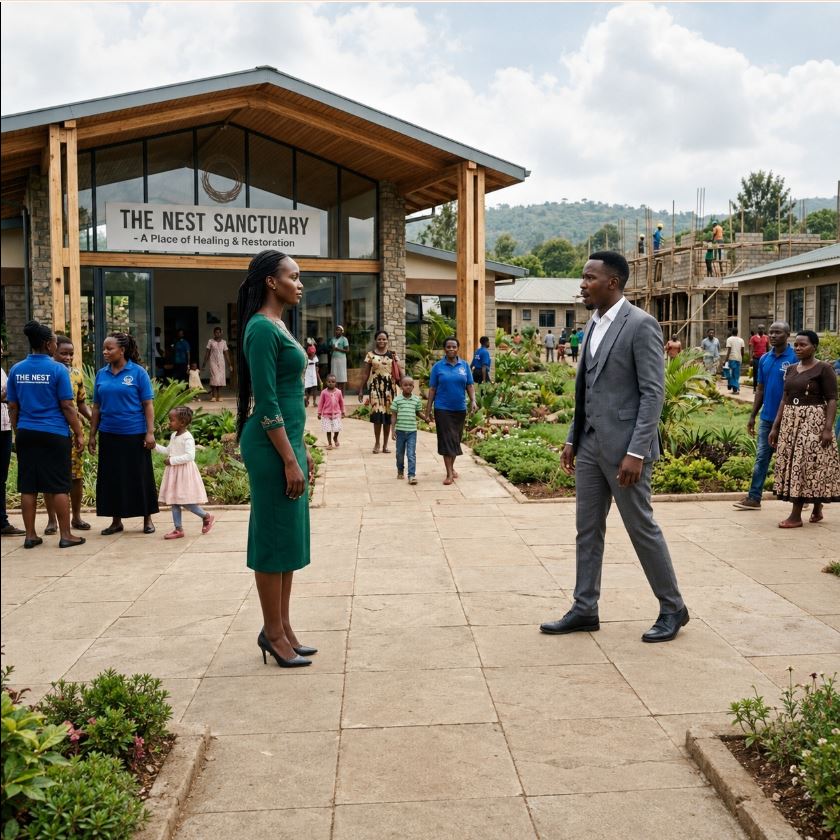
She stepped onto the stage in an emerald dress, her head high, her eyes clear, her body whole and elegant. She was no longer the trembling woman he had left in the rain. She was powerful in a way he could not control.
“Five years ago,” Enkiru began, “I learned how quickly a human life can be discarded when it becomes inconvenient.”
The room went quiet.
“Tonight is not about my pain. It is about what pain reveals. It reveals who profits from silence. It reveals who looks away. But it also reveals how one act of mercy can interrupt generations of cruelty.”
Behind her, images appeared on a screen: women learning trades, women returning to school, mothers holding babies, survivors standing in front of a shelter called Rising Daughters Sanctuary.
Obinna could barely breathe.
The woman he had tried to erase had built a refuge for women like her.
After the speech, people surrounded Enkiru with respect. Donors, officials, journalists, respected leaders. Obinna watched power recognize her, and fear mixed with envy inside him.
Then her eyes found him across the room.
No shock. No panic. No tears.
Only recognition.
Later, he approached her, wearing the face of regret.
“Enkiru,” he said softly. “I hardly know what to say.”
“That makes two of us.”
“I thought you were dead,” she said.
The word cut through him.
“No,” he lied quickly. “I mean… gone. I searched for you.”
Her eyes did not move.
“Did you?”
He tried sorrow. He tried pressure. He tried that old voice that once made her doubt herself. But the woman before him was not the woman he had abandoned.
“If you have something truthful to say,” she told him, handing him a foundation card, “request an appointment.”
That night, Obinna received a message from a woman he had not spoken to in years.
Lillian.
I heard your wife is alive. We need to talk before she remembers everything.
Lillian had been more than his lover. She had helped him hide financial lies, obtain medication, and chase Enkiru’s inheritance. She knew where the rot began.
When they met at a quiet café, Lillian brought copies of old pharmacy records, clinic notes, payments, and dates.
“You truly believed she was too broken to return,” Lillian said.
Obinna tried to threaten her.
She only smiled coldly. “If Enkiru reaches me first, I will tell the truth in the version that saves me best.”
Soon after, Obinna sat across from Enkiru in the conference room of Rising Daughters Sanctuary. But he was not alone with her. Barrister Ada was there. Dr. Akane was there. Records were on the table. Witness statements existed. The truck driver remembered the road. Phone activity showed calls after he abandoned her. Pharmacy records showed sedatives bought repeatedly.
Obinna tried to perform remorse.
“I was under pressure,” he said. “I was not myself.”
Enkiru folded her hands.
“And yet you survived being ‘not yourself’ very well.”
He claimed he had returned to the road.
“No, you didn’t,” she said.
He claimed he did not remember the medications.
Ada opened another file.
When Enkiru finally said, “I was pregnant,” Obinna’s face changed.
For one second, the mask slipped.
“You cannot prove that,” he said.
It was the wrong answer.
Innocent people protest pain. Guilty people protest proof.
Then, in anger, he mentioned Lillian’s name by accident.
The room went still.
Enkiru looked at him and understood.
“So there was someone else in the story.”
That mistake opened the next door.
Barrister Ada found Lillian, and Lillian, sensing that Obinna would sacrifice her first, finally gave a statement. She admitted that Obinna had spoken about Enkiru’s family land before he ever spoke about love. She admitted collecting prescriptions. She admitted hearing him talk about making Enkiru too weak to ask questions. She admitted money had moved through accounts linked to forged land documents.
The truth did not arrive in one dramatic explosion. It arrived piece by piece, document by document, statement by statement.
And when it finally reached court, Obinna’s polished life collapsed.
His business partners withdrew. His creditors came forward. The land scheme was exposed. The stolen inheritance was restored to Enkiru’s name. Lillian testified to save herself. Obinna stood in a courtroom where everyone could finally see what he had hidden behind charm, prayer, and expensive suits.
Enkiru did not shout. She did not beg. She did not perform her pain for sympathy.
She simply spoke the truth.
“I was not abandoned because I was weak,” she said. “I was weakened so I could be abandoned.”
The courtroom was silent.
Justice did not bring back the child she may have lost. It did not erase the rain, the mud, the fever, or the years stolen from her. But it gave her something she had once thought was gone forever.
Her name.
Her voice.
Her future.
With the recovered land and damages from the case, Enkiru expanded Rising Daughters Sanctuary. She built a clinic wing and named it Chisom House, in memory of the child she never got to hold. Mama Ifeoma supervised the workers as if she owned the sun itself. Kunle laughed every time she shouted instructions. Dr. Akane helped design the medical program. Barrister Ada created a legal unit for women trapped in inheritance fraud and domestic abuse.
The place grew into more than a shelter.
It became a road forward.
Months later, Obinna wrote to Enkiru asking for one final meeting.
She agreed, not because she wanted him back, and not because his words could heal her. She agreed because closure sometimes means walking to the edge of an old wound and choosing how close you want to stand.
They met in the small chapel behind the sanctuary just after sunrise.
Obinna looked older, smaller, emptied by the life he had built from lies.
“I was greedy before I was cruel,” he said. “Then greed found pressure, and pressure revealed cruelty.”
Enkiru listened.
He admitted he had not married her for love the way he should have. He admitted he wanted access, security, and land. He admitted that when she became pregnant, fear of losing control became stronger than whatever decency was left in him.
She did not comfort him.
She did not rescue him from his own confession.
When he finished, she stood.
“For years, I thought justice would mean seeing you suffer the way I suffered,” she said. “But that was the part of me still bleeding. Now I know better. Justice was the truth. Justice was getting my name back, my father’s legacy back, my voice back, my work back, and my peace back.”
Obinna lowered his head.
“I forgive you,” she said.
His eyes lifted with sudden hope.
But Enkiru continued.
“I forgive you so what you did no longer rents space inside my spirit. I forgive you so I can walk forward without dragging your shadow. But forgiveness is not reunion. It is not trust. It is not restoration of what you broke. It is release.”
His face crumpled.
“You will live with your choices,” she said. “And I will live beyond them.”
Then she walked out of the chapel without looking back.
Outside, the morning had opened wide. Women were sweeping the paths. Children were laughing near the kitchen. New residents were hanging laundry in the sunlight. Mama Ifeoma stood near the new wing, watching Enkiru with quiet understanding.
“Well?” Mama asked.
Enkiru looked at the building, the women, the land, the life that had grown from what was meant to destroy her.
Then she smiled.
“It’s over.”
Mama nodded.
“Good. Then start the rest.”
And Enkiru did.
Five years earlier, she had been left on a road like something disposable.
Now she had become a road for others.
She never forgot what happened. But memory no longer stood behind her with a knife. It walked beside her with purpose.
That was her greatest victory.
Not just that the guilty were exposed.
Not just that the stolen land returned.
Not just that the world finally believed her.
Her greatest victory was that cruelty did not get to define the rest of her life.
Because sometimes the deepest betrayal comes from the person who promised to protect you. Sometimes the darkest night comes dressed as love. But being broken is not the end of a person’s story.
Sometimes it is the painful beginning of their true becoming.
Enkiru was abandoned in the rain.
But she returned carrying light.
read more in next page